Objects

The items in this online exhibition evoke the stories of American women through the ages.
Click on any image to begin.

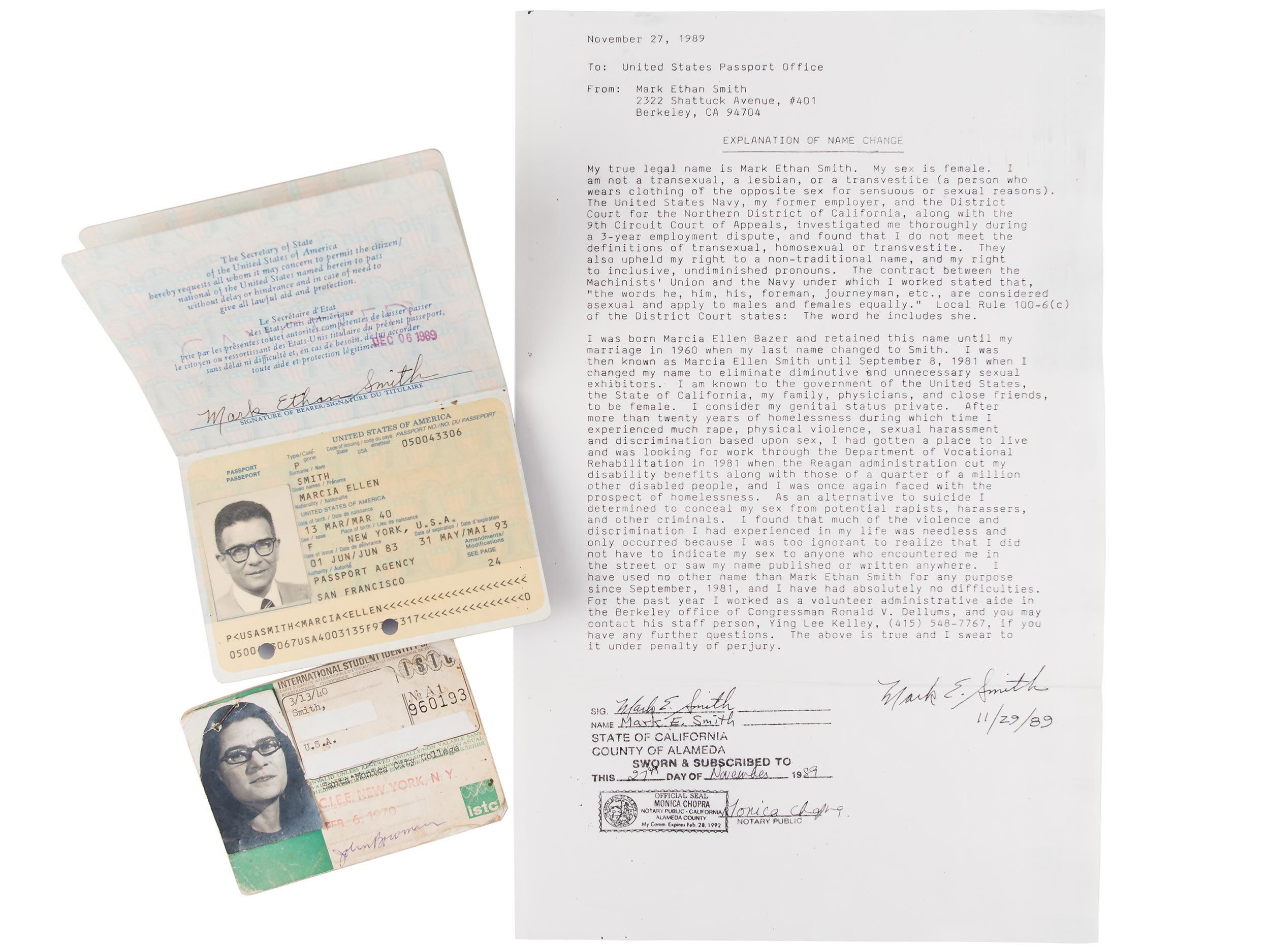
Mark Ethan Smith’s affidavit for legal name change, 1981

Photo by Kevin Grady/Radcliffe Institute

Photo by Kevin Grady/Radcliffe Institute


Mark Ethan Smith self-defines as “a biological female living as a person without regard to sex.” Smith was born Marcia Ellen Bazer in 1940 and has lived an eclectic life, writing poetry in Greenwich Village; traveling to Mexico, Honduras, Thailand, and Afghanistan; founding a commune in California; studying medicine; and volunteering at a hospital in Kabul. Smith’s first marriage, to Francis Xavier Smith in 1960, ended in divorce. In 1981, Smith filed for a legal name change from Marcia Ellen Smith to Mark Ethan Smith. This affidavit, required years later for a passport application, details the reasons for the name change.

Mark Ethan Smith Papers, Schlesinger Library

Catalog record:

http://id.lib.harvard.edu/aleph/007885727/catalog

Learn more:

Learn more by exploring the Schlesinger Library’s research guide to its LGBTQ collection.

View videos of the Radcliffe Institute's 2016 conference, "Ways with Words: Exploring Language and Gender":

WELCOMING REMARKS Lizabeth Cohen, Dean, Radcliffe Institute, and Howard Mumford Jones Professor of American Studies, Department of History, Harvard University OVERVIEW (8:37) John Huth, Codirector of the Science Program, Radcliffe Institute, and Donner Professor of Science, Harvard Faculty of Arts and Sciences, Harvard University PANEL 1: BEYOND BINARIES (19:33) For adults and children, gender identification is often tethered to language shaped by culture.
 
PANEL 2: BIG DATA The Internet, social media, and data mining have changed language and our ability to analyze usage, and increased sensitivities to the power of the words we use.
 
KEYNOTE CONVERSATION Janet Mock, Cultural Commentator, Advocate for Trans Women's Rights, and New York Times Best-Selling Author Discussant: Moya Bailey, Dean's Postdoctoral Fellow, Northeastern University Q&A (46:33)
 
PANEL 3: PUBLIC DISCOURSE This panel will examine language used in the public domain and how it both reflects and shapes cultural attitudes toward gender. The question of who defines and controls language, and the role gender plays, is an important part of political campaigns, entertainment, and business marketing efforts.
 
Heather Min